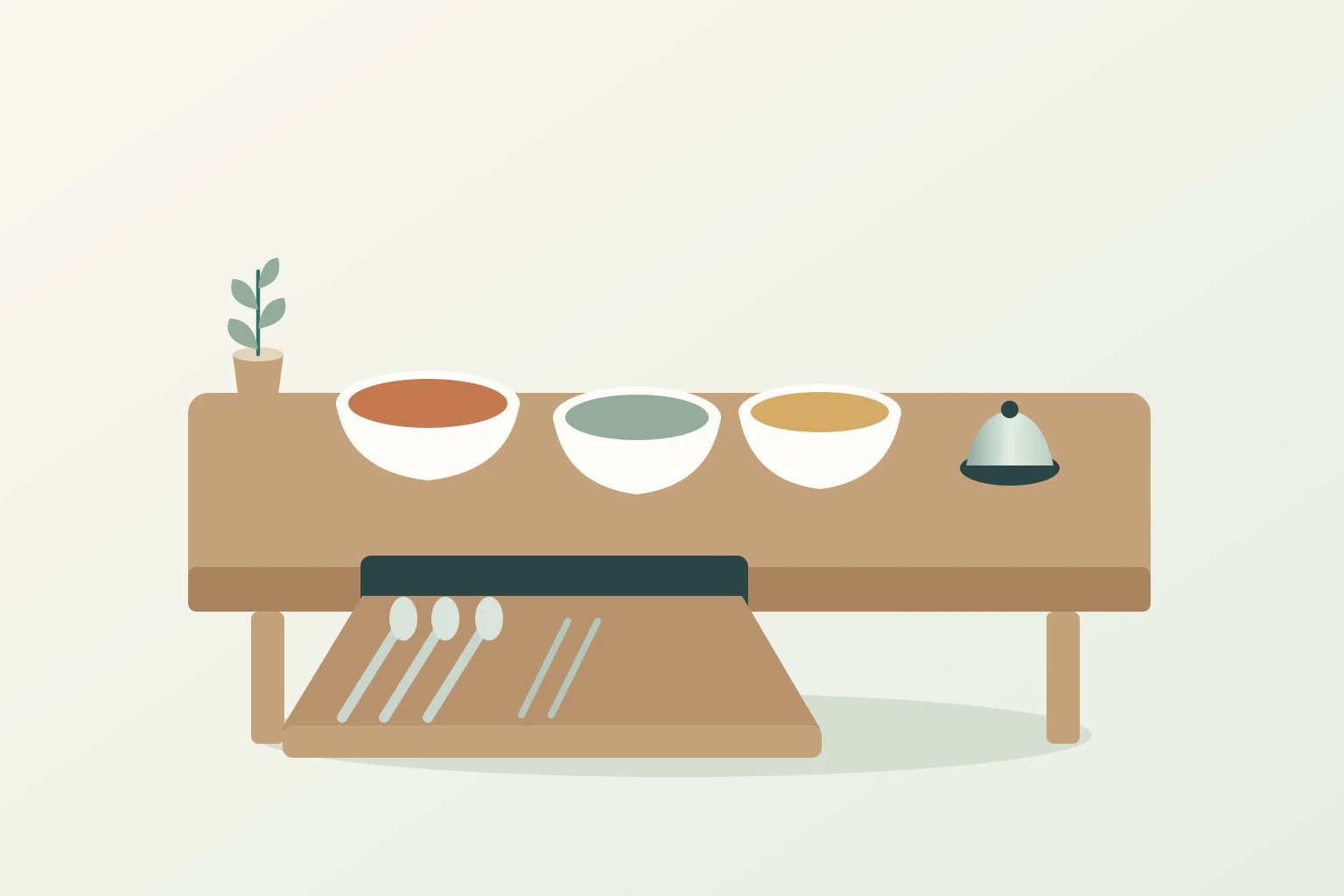
“Where are the chopsticks?” is a perfectly reasonable question when your food arrives and the table still looks empty.
Your first restaurant meal in Korea does not require a long list of ceremonial rules. The useful skill is identifying the setup: who seats you, how you order, what you collect yourself, and where you pay. This guide focuses on those small practical decisions, not on making every meal feel like an etiquette test.
Quick answer
Some Korean restaurants keep utensils in a table-side drawer, provide a call button, or use self-service water and basic side-dish stations. These arrangements are described by the Korea Tourism Organization, but they are not universal. Check your table and the signs, then ask a member of staff rather than waiting indefinitely. [1]
At the table now? Try this first
No utensils: check a visible table-side drawer or utensil holder. No one taking your order: use a visible call bell once, or say 저기요 (excuse me) to a member of staff. No water: look for a 셀프 sign or ask where to get it. If none of these applies, ask rather than opening unrelated storage.
Start at the entrance, not at an empty table
Before sitting down, look for a host, a queue, a sign-in screen or a notice about seating. An empty table may be reserved, awaiting cleaning or assigned through a waiting list. A useful first question is simply whether your party can eat there now.
If you have a reservation, show the confirmation rather than only a map pin. For a walk-in meal, give the actual number of diners. Do not select a larger party just to get past a booking screen.
Read the table before you order
Look for utensils before asking. Use a visible call button once, then allow staff to respond. If there is none, politely attract attention. [1]
Next, identify the ordering method. A paper menu, counter, kiosk and table tablet require different actions. Before pressing a final confirmation button, check the dish, quantity and whether payment happens now or later. If a screen is unclear, ask for help before creating a second order.
These menu words are worth recognizing:
| Korean | Meaning | What to do |
|---|---|---|
| 매장 | Eat in | Choose this when you will eat on the premises. |
| 포장 | Takeaway | Choose this only when collecting food to take away. |
| 추가 | Additional / extra | Check the displayed price before adding it. |
| 1인분 | One serving | Check any minimum order separately. |
Water, side dishes and extras are different questions
A 셀프 sign means self-service. Check what it covers. Basic banchan refills are commonly free; extra rice, meat or separately listed dishes are not automatically included. [1]
A practical way to avoid over-ordering is to confirm the main dish first, then ask what comes with it. Do not assume everything pictured on a menu is included in the displayed price.
For dietary requirements, identify the actual ingredient you need to avoid and ask the restaurant directly. A translated dish name or photograph is not a reliable substitute for an ingredient check. When you cannot get a clear answer, choose another dish or venue rather than treating uncertainty as confirmation.
Finish the meal without guessing the payment routine
Ask where to pay and check the final amount before completing the transaction. If your group needs separate payments, raise that question before everyone starts ordering; do not assume the system can split an existing bill in your preferred way.
Tipping is not normally expected in ordinary Korean restaurants. You do not need to add a tip just because you are used to doing so at home. [1]
Keep the receipt until you are satisfied the correct meal and amount were charged. If something looks wrong, point to the relevant item and ask calmly while you are still at the counter.
Four phrases to keep on your phone
수저가 어디에 있어요? — Where are the utensils?
주문해도 될까요? — May I order?
계산할게요. — I would like to pay.
어디에서 계산하면 되나요? — Where should I pay?
Frequently asked questions
Are side-dish refills always free?
Do not treat “side dish” as a promise that every extra item is free. Check whether it is basic banchan or a separately priced menu item, and ask before ordering.
Should I wait for staff to grill the meat?
Some restaurants provide staff grilling. Ask who handles the grill at yours, and request guidance before using unfamiliar equipment. [1]
Your next move
For your first meal, choose a place whose menu and ordering process you can understand. Confirm the number of diners and the minimum order before sitting down. Getting those two details right is more useful than memorizing a long list of dining rules.
Sources and review
- About Korean Food — Visiting a Korean Restaurant — Korea Tourism Organization.
Editorial review: September 13, 2026. This review did not include an in-person restaurant visit. Seating, ordering, refills and payment procedures remain venue-specific. This date records the review of this guide, not a claim of a completed customer transaction.