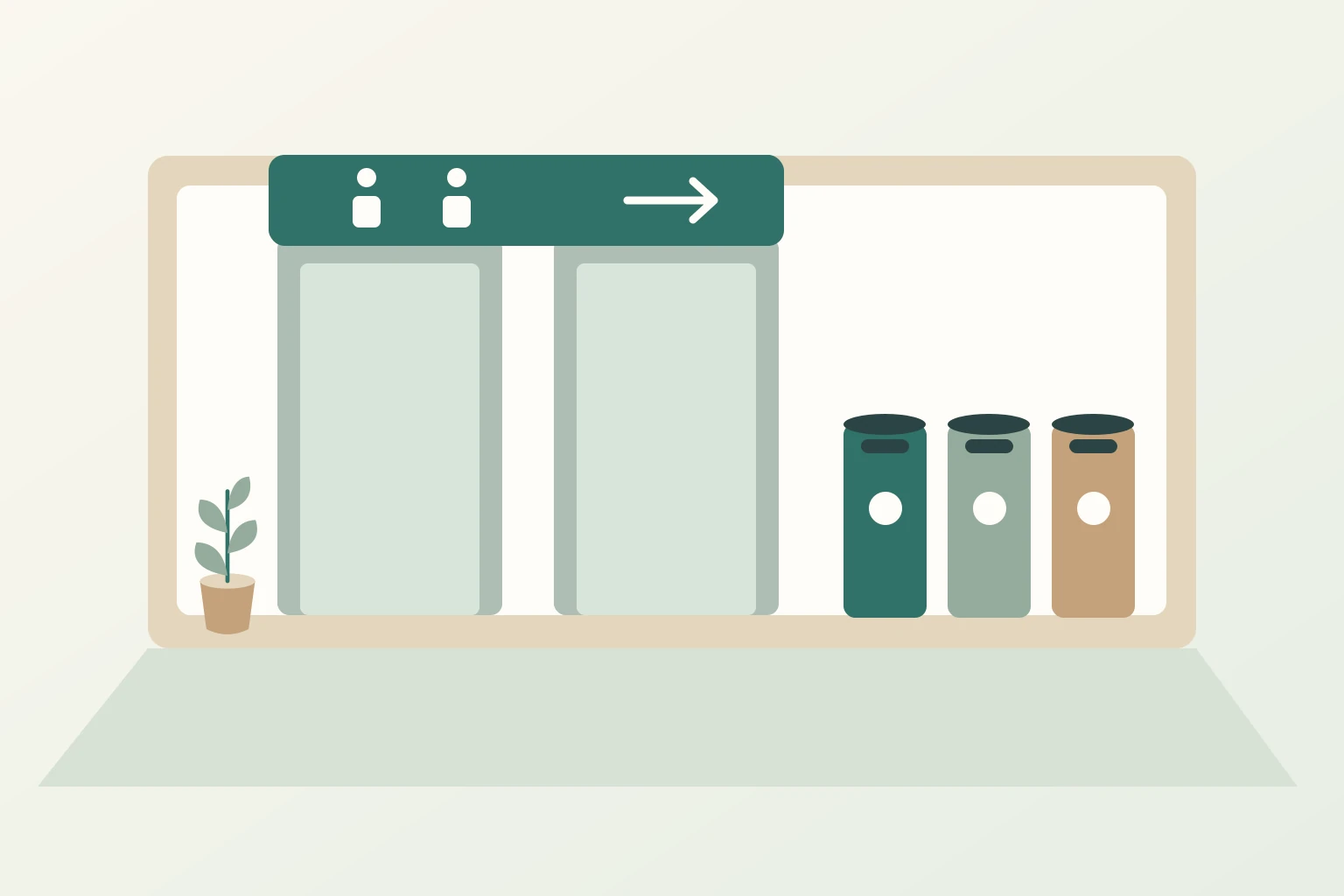
You have planned the museum and the café. Then you need a bathroom, cannot find a bin for an empty cup, and discover that your hotel does not include the toothbrush you expected.
These are small problems, but they can interrupt a good day. The practical approach is to know where to look, what to ask and which assumptions to avoid.
Quick answer
For a restroom, start with a known facility rather than wandering at random. Seoul’s subway accessibility tables include accessible restrooms at listed stations, and the city’s Hangang park information lists facilities by park. Check the actual entrance, opening hours and access before relying on a location. [1] [2]
For rubbish, use a designated bin or keep small items with you until you find one. Seoul does have public bins; their existence does not guarantee one will be beside you when you finish a drink. [3]
Need a restroom now?
In a station, ask staff or check the facility map. In a café, ask before searching for a keypad code. On a street, search 공중화장실 (public restroom) and check the building entrance and access information before walking there.
Show this: 가장 가까운 이용 가능한 화장실이 어디예요?
Where is the nearest restroom I can use?
If step-free access matters, ask specifically: 계단 없이 갈 수 있나요? — Can I reach it without stairs?
Find the restroom before it becomes urgent
When entering a station, museum, shopping centre or park, notice the nearest restroom sign. For a map search, 공중화장실 means public restroom. 개방화장실 can help you search for a restroom opened for public use, but the listing still needs an access and opening-hours check.
At a subway station, look at the station map or ask staff. If the facility is beyond fare gates, ask how to reach it; do not cross a gate without permission or assume an extra entry is free.
If you need step-free access, an accessible cubicle or a baby-changing facility, check that requirement specifically. A generic bathroom pin does not confirm the route, equipment or current availability.
In a café, ask about access
If the restroom door is locked or a keypad is present, ask the business how to enter. Do not assume the café has a private restroom, that every facility is open to non-customers, or that an old access code found online still applies.
Two useful questions are:
화장실이 어디예요? — Where is the restroom?
화장실 비밀번호가 있나요? — Is there a restroom access code?
Check that toilet paper is available before you need it. Carrying a small packet of tissues is a reasonable backup, but it is not a reason to flush every type of tissue.
Toilet paper and wet wipes are not the same thing
Do not follow the blanket advice that all toilet paper in Korea belongs in a bin. Official public-restroom guidance distinguishes ordinary toilet paper, which is intended for the toilet, from sanitary products collected separately. Follow clear facility instructions and ask staff if the signage is contradictory. [4]
Wet wipes are a different matter. The environment ministry’s 2026 guidance says they belong in a bin, not in the toilet. Put wipes and sanitary products in the designated receptacle; do not assume a product dissolves because its packaging sounds convenient. [5]
A restroom bin is not an invitation to dispose of takeaway food, drinks or a bag of household waste there.
Deal with rubbish by its label, not by the nearest opening
Keep a small bag for an empty wrapper or other light rubbish until you reach an appropriate disposal point. If you are still in the shop that served you, ask where its customers should put packaging rather than leaving it on a counter.
These labels help you ask the right question:
| Korean | Meaning |
|---|---|
| 일반쓰레기 | General waste |
| 재활용 | Recycling |
| 음식물쓰레기 | Food waste |
The table translates the labels; it does not determine the correct category for every item. Do not put food-covered packaging into a food-waste container simply because it came with food. Follow the posted sorting instructions or ask the venue.
For an apartment or holiday rental, ask the host about its designated collection place, bags and schedule. Do not use a street bin as a substitute for the property’s household-waste process.
Two other small surprises to plan around
A takeaway drink and a Seoul city bus
Seoul’s city-bus guidance restricts spill-prone food and drinks, including drinks in disposable cups, and distinguishes them from securely closed containers. Do not treat a loosely fitted takeaway lid as permission to board. This is a Seoul city-bus rule, not a claim that every form of Korean transport has identical restrictions. [6]
Finish or appropriately store the drink before your bus arrives. That is easier than deciding what to do while other passengers are boarding.
The toothbrush you expected at your hotel
Check your accommodation’s amenities list before travelling. For example, Koreana Hotel publishes a policy about disposable toiletries rather than promising every such item free of charge. That is a reason to confirm your own booking, not to assume all Korean hotels provide the same supplies. [7]
Bring your own essentials or find out which items the property sells. Do not interpret the absence of a disposable toothbrush as proof that all toiletries are missing.
Frequently asked questions
Are all Seoul restrooms free and open around the clock?
Do not assume either condition. Check the actual facility, building access and opening hours, especially late at night.
What should I do when I cannot work out where rubbish belongs?
Keep it with you briefly and ask: 이 쓰레기는 어디에 버리면 되나요? — Where should I put this rubbish? A clear question is better than guessing at an unfamiliar sorting point.
Your next move
Before a long walk, note one accessible restroom on your route, carry your own small essentials and leave room in your bag for temporary rubbish storage. A few simple preparations keep small interruptions from controlling the day.
Sources and review
- Subway Accessibility Facilities — station facility tables — Seoul Metropolitan Government.
- Hangang Parks — facilities — Seoul Metropolitan Government.
- Street-bin installation information (Korean) — Seoul Metropolitan Government.
- Public-restroom toilet-paper and sanitary-bin guidance — Ministry of the Interior and Safety.
- Wet wipes belong in bins, not toilets — Ministry of Climate, Energy and Environment.
- Specified Provisions for Foods Prohibited from Carry On — Seoul Metropolitan Government.
- Disposable amenities — hotel FAQ — Koreana Hotel.
Editorial review: September 15,, 2026. This review did not include a facility-access survey. Opening hours, accessibility, signage and accommodation policies must be checked locally. This date records the review of this guide, not a claim of a completed customer transaction.